

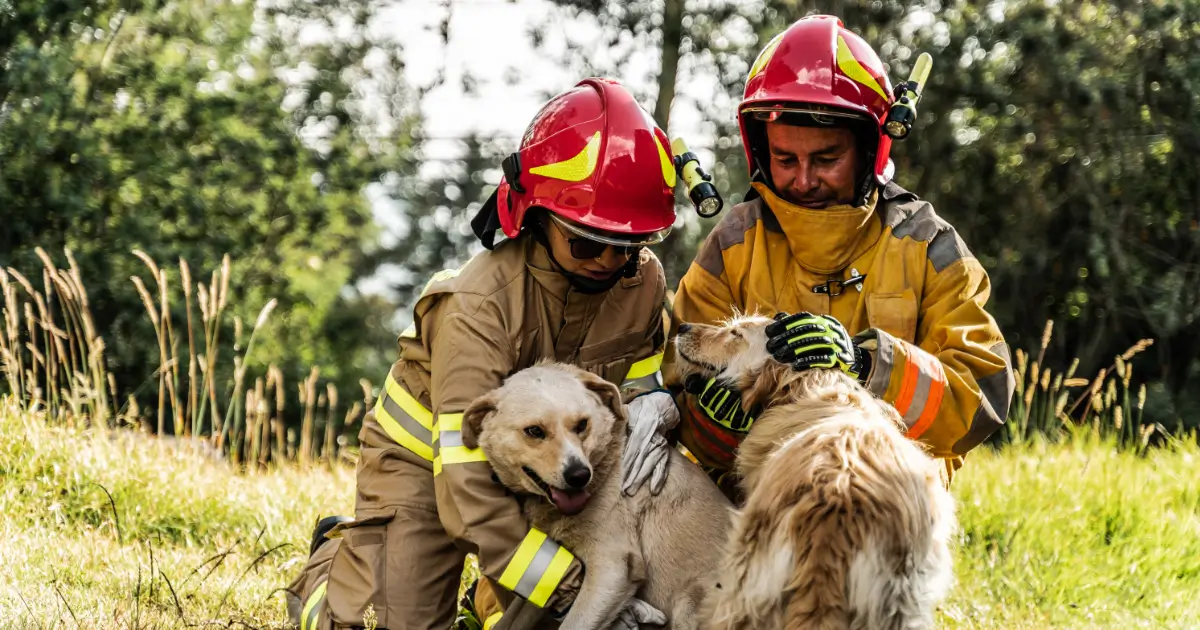
National Pet Fire Safety Day: Keeping Your Dogs Safe Before, During, and After a House Fire
July 15 is National Pet Fire Safety Day, created by the American Kennel Club and ADT Security Services to raise awareness about house fires and pets. In this guide, we’ll walk through practical Pet Fire Safety Tips to protect your dogs before, during, and after a house fire.
The good news is that nearly all of it is preventable with an afternoon of preparation. Here’s what the AKC, the ASPCA, the American Red Cross, and fire departments across the country recommend.
Pet Fire Safety Tips: Prevent your pet from starting a fire
Yes, pets start fires. About 1,000 a year. Here’s how to make sure yours isn’t one of them:
Cover or remove stove knobs. According to the NFPA, the stove or cooktop is the number one piece of equipment involved in pets starting fires. A counter-surfing dog can bump a knob and turn on a burner without you ever knowing. Remove the knobs or use covers before leaving the house.
Extinguish open flames. Pets are curious and will investigate candles, fireplaces, and cooking appliances. Never leave a pet unattended around an open flame, and put everything out before you leave.
Switch to flameless candles. These use a light bulb instead of a flame, so a wagging tail or a curious cat can’t knock over a fire hazard.
Secure electrical cords. Chewed cords are a shock and fire risk, especially with teething puppies. Keep chargers and appliance cords out of chewing reach and toss anything that’s been gnawed.
Skip glass water bowls on wooden decks. Sunlight filtering through glass and water can heat up and ignite the wood underneath. Use stainless steel or ceramic outside.
Keep the three feet rule. Pets should stay at least three feet from space heaters, fireplaces, and other heat sources.
Make your pet easy to rescue when you’re not home
If a fire starts while you’re at work, firefighters become your pet’s only chance. Set them up to succeed:
Put a pet alert cling on a front window. Write down the number and type of pets inside so first responders know who to look for. Keep it updated. The ASPCA mails a free pet safety pack that includes one, and free clings are also available through local volunteer firehouses in partnership with the National Volunteer Fire Council.
Keep pets near entrances when you’re away. The AKC recommends keeping home-alone pets in areas close to entry doors where firefighters can find them quickly. Confine young puppies in crates or behind gates in a secure area near an entrance.
Know your pet’s hiding spots. Scared animals hide. Note where yours goes when frightened so you can tell firefighters exactly where to check.
Keep collars on and leashes by the door. A collar makes a frightened pet easier for rescuers to handle, and visible leashes mean anyone can grab and go.
Microchip and update ID tags. If your pet escapes or is rescued while you’re away, current contact info is what gets them back to you.
Consider monitored smoke detectors. Pets can’t dial 911. A monitored system alerts emergency responders even when nobody’s home, which for pets who are always home alone during the day is the single biggest upgrade you can make.
Build a family escape plan that includes your pets
One of the most important Pet Fire Safety Tips is to make your escape plan include your pets from the beginning, not as an afterthought. Fire departments recommend every household practice an escape plan, and your pets are part of the household:
Know two ways out of every room. This is standard fire department guidance for a reason: your primary route may be blocked. Keep both paths uncluttered.
Assign a person to each pet. In a multi-person household, everyone should know exactly which pet they’re responsible for grabbing.
Practice drills with your pets. You may have as little as two minutes to get out. Practicing gets pets used to the routine and tells you how long evacuation actually takes.
Pick an outside meeting spot. Everyone, pets included, should end up at the same place.
Pack a pet emergency kit. At least three days of food, any medications, and copies of vet records.
Never go back inside. Do not delay your escape and never re-enter a burning building for a pet. Get out, then immediately tell firefighters your pet is inside and where they hide. Many departments carry pet oxygen masks and rescue pets successfully all the time.
The upstairs scenario: Getting a dog out an upper window
Here’s one gap in most pet fire safety plans. If you live in a two-story house, a split-level, or an upstairs apartment, there’s a real chance a fire on the lower level blocks your stairway before you’re even awake. Fires most often start in kitchens, living rooms, and basements. That’s why the two-ways-out rule matters, and on an upper floor, your second way out is a window. You can climb down an escape ladder. Your dog can’t. So if your dogs sleep upstairs with you, your plan needs to cover them too.
Escape ladders for the humans. Every upper-floor bedroom should have one. Portable two-story ladders from brands like First Alert and X-IT hook over the windowsill and stow under a bed, and permanently installed models mount below the window so they’re always ready.
A lowering harness for medium and large dogs. Search and rescue teams and climbers have lowered dogs on ropes for decades, and the gear is available to regular pet owners. The Ruffwear Doubleback is a full-body belay harness built specifically for lifting and lowering dogs, strength-rated to 2,000 pounds of force, with metal buckles and leg loops that spread the load (around $150). The Singing Rock Laika is a rescue harness designed for helicopter dog transport, rated to 330 pounds (about $130). Pair either with 50 feet of quality rope and a locking carabiner, and keep the kit in the bedroom.
A pet evacuation bag for small and medium dogs and cats. These are heavy-duty enclosed carriers with mesh ventilation and lowering straps, typically sold with a 50-foot rope, in sizes for pets up to 55 or 100 pounds. They double as backpacks so you can also carry your pet down a ladder. Around $45 to $60.
A reality check. Lowering a dog from a window is a last resort, not Plan A. If you’re trapped and can’t get out safely, fire officials say to shelter in a room with the door closed, seal gaps with towels, call 911, and signal from the window. Firefighters rescue people and pets from upper windows all the time. The gear is for when staying put isn’t an option, and having it ready beats improvising with a bedsheet at 3 a.m.
Practice matters most. The ASPCA recommends testing evacuation routes with your pet before an emergency happens. A dog who has worn the harness a dozen times will tolerate it in a crisis. A dog meeting it for the first time during a fire will fight you.
Your National Pet Fire Safety Day checklist
Use this National Pet Fire Safety Day checklist to put key Pet Fire Safety Tips into action in your home.
- Test every smoke alarm in your home, and replace any detector over ten years old.
- Cover or remove stove knobs and swap real candles for flameless ones.
- Put a leash by the door and a pet alert cling on a front window.
- Walk your escape routes, including your backup route, with your dog.
- If your bedrooms are upstairs, add an escape ladder for you and a lowering harness or evacuation bag for your dog.
- Pick an outside meeting spot for the whole family, paws included.
It takes one afternoon, and it protects the family members who can’t save themselves.
Stay safe out there, Fargo-Moorhead. We’ll handle the yard. You handle the fire drill.
Dog Poo Crew has been keeping Fargo-Moorhead yards clean since 2006. While you’re planning your fire drill, let us take one chore off your plate for good.